April 16, 2026
One Product Photo, Endless Lifestyle Scenes: AI Scene Generation Explained
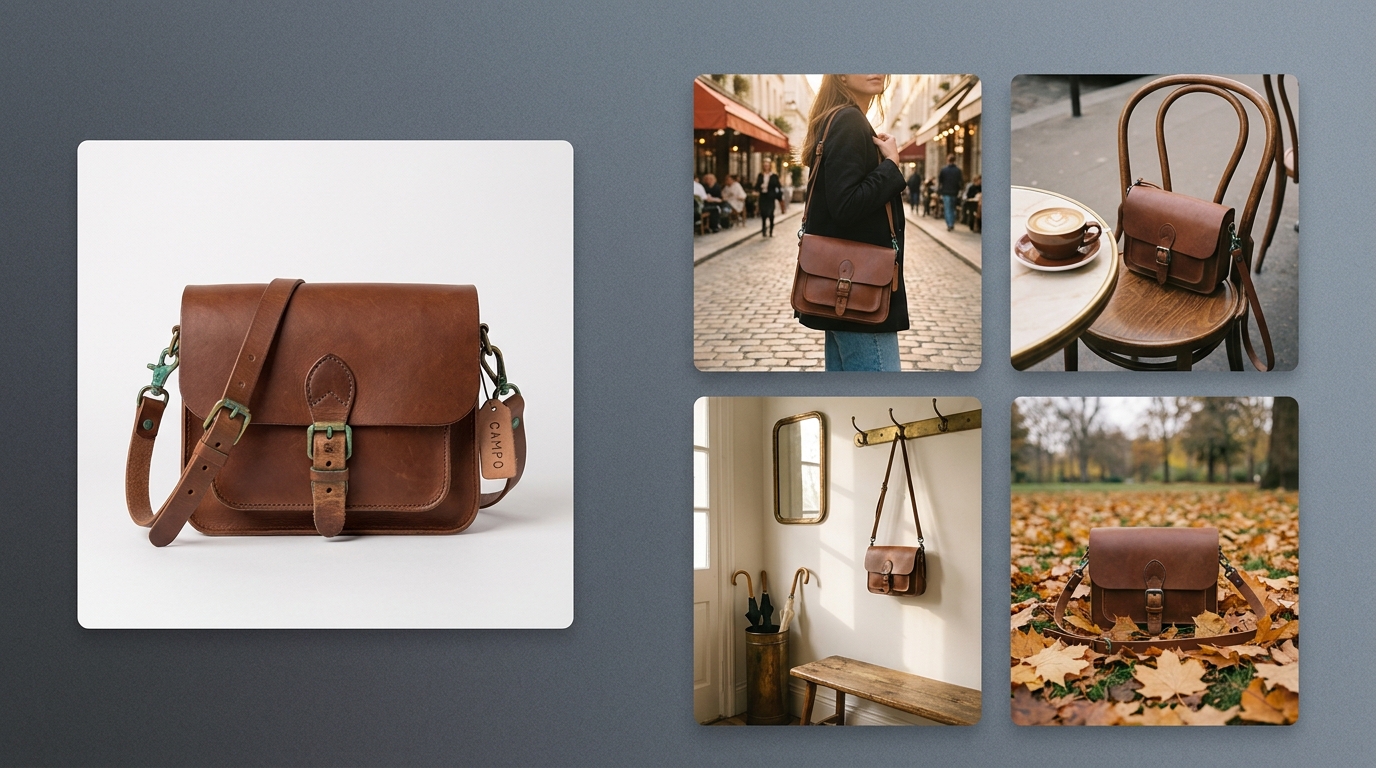
A brown leather satchel on a white background is a product photo. That same satchel slung over a shoulder on a cobblestone street, resting on a café chair beside a latte, hanging from a brass hook in a sunlit entryway, or sitting on autumn leaves in a park — those are stories. Stories sell products.
The gap between a clean product shot and a full library of lifestyle product photography has always been budget, logistics, and time. You need locations, props, sometimes models, always a photographer, and enough post-production to make it all cohesive. For most ecommerce sellers, that math doesn't work — so they settle for one or two images and move on.
AI product scene generation changes that equation. One source photo becomes the raw material for as many lifestyle scenes as your marketing strategy demands. No location scouts. No prop budgets. No weather delays.
Why Lifestyle Context Moves Products
A product on a white background answers the question "what does it look like?" A product in a lifestyle scene answers "what would it feel like to own this?" That second question is where purchase decisions happen.
When a shopper sees a bag on a café table, they're not evaluating the leather or the stitching — they're imagining themselves in that scene. The bag becomes part of a lifestyle they want. That mental leap from "nice product" to "I need this in my life" is where conversion happens. It's why fashion brands invest in editorial shoots, why furniture companies stage entire rooms, and why food brands photograph their products in magazine-worthy kitchens.
Lifestyle ecommerce images also perform better in advertising. Social media platforms reward content that feels native to the feed — a product floating in white space doesn't feel native anywhere except a marketplace listing. A styled scene stops the scroll because it looks like content, not a catalog entry. For paid social, email campaigns, and website hero sections, lifestyle imagery consistently outperforms plain product shots in engagement and click-through.
The challenge has never been whether lifestyle photos work. It's always been whether you can afford to produce enough of them. A 10-product lifestyle shoot with a photographer, stylist, and location rental typically runs $5,000–15,000 — and that gets you one scene per product, maybe two if the day goes well.
How AI Scene Generation Actually Works
The process is simpler than most sellers expect. It starts with background removal — the AI isolates your product from whatever background it was photographed on, leaving a clean cutout with precise edges. Then, instead of manually compositing that cutout in Photoshop, the AI generates an entirely new scene around your product.
This isn't pasting your product onto a flat background image. The AI understands lighting direction, shadow behavior, surface reflections, and spatial context. It generates a scene where your product looks like it belongs — shadows fall correctly, reflections match the surface, and lighting stays consistent with the environment.
With Flyshot's AI scene generation, you describe the scene you want — or choose from style presets — and the AI handles the rest. The output is a finished lifestyle image ready for your store, your ads, or your social feed. The entire process takes minutes per image, not hours or days.
What Makes a Good Lifestyle Scene
The AI handles the technical compositing, but the scene choices are yours — and they matter more than most sellers realize. A few principles from professional product photography translate directly:
Lighting direction should match your product photo. If your source photo was lit from the upper left, a scene with sunlight streaming from the right will feel subtly wrong even if viewers can't articulate why. Shoot your products with soft, slightly directional light — it gives the AI the most flexibility to match a wide range of environments.
Color palette harmony sells the scene. A warm-toned leather bag looks natural on a wooden café table or against terracotta. Place it in a cool-toned minimalist interior and the mismatch creates visual tension. Think about whether your product's tones are warm, cool, or neutral, and choose scenes that complement rather than clash.
Scale and context need to make sense for the category. A watch on a mountainside boulder works because the scale relationship is clear. A tube of lip balm in the same scene looks lost. Small products need intimate settings — a vanity, a desk, a hand. Large products can handle expansive environments. Match the scene's scope to your product's physical presence.
The scene should support the product, not compete with it. A busy, colorful market scene might look gorgeous on its own, but if your product disappears into the visual noise, it's the wrong choice. The best lifestyle scenes have enough context to tell a story while keeping the product as the clear focal point — think soft backgrounds, complementary (not competing) props, and enough negative space for the eye to land on what you're selling.
Choosing Scenes That Match Your Brand
This is where strategy matters more than technology. Having the ability to generate unlimited scenes doesn't mean you should use every option available. The scenes you choose should reinforce your brand identity, not dilute it.
Start by thinking about your customer. Where do they use your product? What aspirational context resonates with them? A rugged canvas backpack belongs on a mountain trail or in a vintage Land Rover — not in a minimalist Scandinavian apartment. A luxury skincare product belongs on a marble vanity — not on a picnic blanket. The scene should feel like a natural extension of your product's story.
A few practical guidelines:
- Match the environment to your price point. Premium products need premium settings. Budget-friendly products can feel approachable in casual, everyday scenes.
- Stay consistent across your catalog. If your brand aesthetic is warm and earthy, don't suddenly generate a product scene with cool blue tones and chrome surfaces. Visual consistency across your product catalog builds trust and recognition.
- Think in terms of channels. Your Amazon listing needs a clean white background as the main image — that's non-negotiable. But your secondary gallery images, your Instagram grid, your email headers, and your website banners all benefit from different lifestyle treatments of the same product.
- Rotate seasonally. One of the biggest advantages of AI-generated product photo backgrounds is the ability to create seasonal content without reshooting. Generate autumn scenes in October, cozy indoor scenes in December, bright outdoor scenes in spring. Same product, fresh visuals, zero additional photography.
The brands that get the most value from scene generation aren't the ones generating the most images — they're the ones generating the right images for each context.
Building a Visual Marketing Strategy From One Photo
The real power of this approach isn't any single image — it's the system. When one product photo can produce a dozen lifestyle variations, your visual marketing strategy stops being constrained by production capacity.
Consider what a single well-shot product photo can become: a white background cutout for your marketplace main image, a lifestyle hero for your product detail page, 3-4 styled scene variations for your gallery, seasonal scenes for email campaigns, social-native lifestyle images for Instagram and Facebook ads, and A/B test variants to learn which environments your audience responds to. That's 8-10 distinct assets from one capture session. Multiply across a catalog of 50 products and you're looking at hundreds of unique images — volume that would cost tens of thousands in traditional photography.
The workflow is practical for a solo seller: shoot your products with clean lighting and a simple background, upload them, remove the backgrounds, and generate scenes. Apply the same style presets across your catalog for visual consistency. The per-product effort is measured in minutes, not hours.
For brands running paid advertising, this unlocks a testing cadence that wasn't previously realistic. Instead of committing to one lifestyle image per product, you can generate five variations and let the data tell you which scene resonates. You won't know whether your audience prefers outdoor settings or indoor ones until you test — and testing requires volume.
From One Photo to an Entire Brand Experience
Pick your best-selling product and try Flyshot free — generate three scenes for three different channels and put them to work. The real test isn't whether the images look good. It's whether they outperform what you're running now.